


Why Adam Carr believes the best litigators know when not to litigate
Adam Carr, Senior Associate at Brisbane-based JCL Law Partners, has spent a decade working in insolvency and litigation from several different perspectives.
Having worked in private practice as well as for the Australian regulators responsible for personal and corporate insolvency, Adam has seen what happens when disputes reach the courtroom, but also understands why avoiding that outcome can sometimes be the bigger success.
‘Litigation is fun. I love it, and it’s good for lawyers, but it can be really bad for clients,’ he says. ‘It takes years off their life, it costs lots of money and even if you have the best case in the world, you can never guarantee a win.’
His enthusiasm for his work goes hand in hand with keeping his clients’ interests front of mind.
Changing course
Becoming a lawyer was not always the plan. After leaving school, Adam spent more than two years studying for a Bachelor of Education with the intention of becoming a primary school teacher, but practical experience in schools eventually convinced him it was not the career for him.
Also working as a paralegal at the time, Adam made the switch to study law with encouragement from one of the firm’s partners.
His route into insolvency was similarly unplanned. ‘I don’t believe I even studied insolvency at university,’ he laughs.
Instead, a barrister teaching Adam during his practical legal training connected him with his first role after graduation. The firm happened to specialise in litigation and insolvency. ‘I kind of just fell into it initially,’ Adam admits. ‘Then once I got stuck in, I really enjoyed it. I still do.’
Seeing insolvency from both sides
After beginning his career in private practice, Adam moved into the regulatory space, spending around three years with the Australian Financial Security Authority (AFSA), Australia’s personal insolvency regulator.
He later joined the Australian Securities and Investments Commission (ASIC), where his work brought him into the corporate insolvency space and included significant involvement with the ASIC Assetless Administration Fund, which funds liquidators to investigate and report on suspected director misconduct in companies with few or no assets.
Having spent much of his career working for regulators before returning to private practice gives Adam a perspective he now brings to his work at JCL Law Partners, helping him anticipate how different parties are likely to approach a matter.
‘I try to fold the regulator stuff into my day-to-day and try and build my practice in those areas as well,’ he explains.
Today, his work can involve acting for liquidators and trustees on investigations, public examinations, court applications and recovery actions. On other matters, he may find himself on the opposite side, acting for directors and defending similar claims.
Back in private practice
After joining JCL Law Partners in February 2025, Adam now works primarily across litigation and insolvency, while also helping to supervise junior lawyers within the firm.
Private practice keeps him on his toes. ‘One day I’ll be in court, another I’ll be drafting contracts, then we could be having a mediation, or I’ll be giving some advice,’ he details. ‘The theme of insolvency is always pretty much the same, but the issues are always different.’
Adam also values the broader experience that comes with being part of a boutique firm. ‘Since I’ve been here, I’ve been exposed to a lot of different things,’ he says.
Knowing when to settle
Adam is clear that taking a dispute as far as possible is not necessarily the best measure of success. He points to a recent shareholder dispute involving a settlement of around A$10 million. The matter could easily have proceeded to court, but the JCL team believed there was a better option.
‘We could see it should have been settled, and we settled it,’ he says. ‘We brought it on to mediation early, didn’t even have to file any application and just resolved the dispute.’
This is an approach Adam feels strongly aligned with at the firm. ‘I’m proud of our firm and I’m proud about that aspect of what we do,’ he says. ‘We’re genuine people that are actually here to help.’
An early lesson in advocacy
One of Adam’s proudest achievements came before he had even qualified as a lawyer. While studying, his now-wife was working in Australia on a sponsored visa and Adam became concerned that her employer was underpaying her. ‘I felt they were taking advantage,’ he recalls.
Still a law student, he began compiling evidence and pursued the matter through the Fair Work Commission and the Fair Work Ombudsman. The unfair dismissal and underpayment claims were successful, but the consequences went beyond the issue he had initially set out to address.
Further investigation uncovered underpayments affecting other employees, with action ultimately extending across the company.
‘I put in so much effort to put all this evidence together,’ he says. ‘It went much bigger because they discovered that all the employees were getting underpaid.’
Adam now sees this as an early introduction to the type of work he would later pursue professionally. ‘I’m very proud of that, standing up for people who might not otherwise have had a voice,’ he reflects.
The human side of insolvency
That awareness of the person behind a legal problem has remained important throughout Adam’s career.
‘In insolvency, you get the human element of it,’ he explains. ‘You’re dealing with people that have had their head in the sand or people that are going to lose assets. It can be the last straw for them.’
Learning how to manage that emotional side of legal work came early on. During his practical legal training, Adam worked with Justice Connect in homelessness law, supporting people experiencing extremely difficult circumstances.
He still tries to achieve the best possible result for clients while recognising the importance of not absorbing every aspect of their situation himself. ‘You just get better at managing that balance over time.’
Becoming the final stop
For younger lawyers, Adam’s first piece of advice reflects his own unconventional career path: do not specialise too quickly. ‘Don’t pigeonhole yourself too soon,’ he says. ‘Try and go across as many things as you can.’
But as responsibility grows, so should ownership of the work. Adam sees a point in every lawyer’s development when they need to stop assuming somebody more senior will ultimately correct their work. ‘Somewhere along the line, nobody is going to fix it for you, so you need to be the final stop.’
He brings this lesson to his role supervising junior lawyers within the firm, encouraging them to build experience while gradually taking greater accountability for the matters in front of them.
Connecting Australia and Korea
One area Adam is particularly interested in developing is cross-border work between Australia and South Korea.
After making Korean friends at university, Adam became curious about the language and began picking up words through conversation. He taught himself the Korean alphabet, built his vocabulary and immersed himself in Korean music and television before undertaking formal study. He also met his wife through the same group of friends.
‘I read, write and speak Korean,’ he reveals. ‘I started listening to Korean music and watching Korean dramas in 2009 – way before it was popular,’ he laughs.
Adam is now exploring how those skills could form a greater part of his professional life, including building relationships with Korean companies operating in Australia.
It is also one of the areas where he sees potential in IR Global. As a Rising Star, Adam is still relatively new to the network, but is already looking to build relationships with members in Korea and plans to attend the ‘On the Road’ conference in Hong Kong in March 2027.
‘I want to keep broadening my practice,’ he says. ‘I’d like to branch out and do more regulatory and cross-border work with Korea.’
Switching off
Finding downtime is something Adam admits does not always come naturally. ‘Work is demanding in a good way, and home life is demanding in a good way,’ he says.
Much of his time outside the office is spent with his young family, including his six-year-old son. Having previously enjoyed running and exercise, Adam hopes to return to it as his son gets older, potentially with a new running companion alongside him.
There is, however, one pastime that reliably helps him switch off: cars. A long-standing car enthusiast, Adam enjoys watching videos of damaged vehicles being rebuilt and restored. ‘That relaxes me,’ he says. ‘It’s kind of therapeutic.’


Expert Determination: The Quiet Power Player in High-Value Commercial Disputes
Not every high-value commercial dispute needs to end up before a judge. Where a disagreement turns on a technical, accounting or valuation issue, expert determination can provide a more focused way of reaching an outcome.
The process is not new, but it continues to play an important role in complex commercial agreements. It is particularly useful where specialist knowledge is more important than extensive legal argument and where the parties want to resolve a defined issue without committing to lengthy court proceedings.
That role can be seen in current Queensland contracting. As an example, Powerlink – Queensland’s electricity transmission network – includes a detailed dispute resolution procedure in their Load Connection and Access Agreement template, under which certain unresolved disputes can progress from senior management to an independent expert. The agreement also addresses the expert’s qualifications, appointment, procedural rules and the circumstances in which a determination will be binding.
What Is Expert Determination?
Expert determination is a form of Alternative Dispute Resolution in which an independent expert is appointed to decide a particular issue between the parties.
Unlike a mediator, the expert does not simply assist the parties to negotiate an agreement. They reach a determination themselves. The expert might be an accountant asked to resolve a completion accounts dispute, a valuer determining the value of an asset or an engineer considering a technical issue arising from a major project.
Whether the decision is binding, and the extent to which it can later be challenged, will usually depend on the wording of the relevant contract or expert determination agreement.
Where Expert Determination Works Best
Expert determination tends to work best where a dispute can be reduced to a clearly defined question requiring specialist expertise.
Valuation disputes are a common example. If parties disagree over the value of shares, property or another asset, referring the issue to an experienced valuer may provide a more direct route than asking a court to consider competing expert evidence.
Speed Does Not Mean Simplicity
One of the main attractions of expert determination is the potential to obtain an answer more quickly than through traditional litigation.
That should not be confused with an informal process or one that requires little preparation. The sums involved can be substantial, and an expert’s decision may be final and binding. The parties still need to understand the precise question being referred, identify the relevant evidence and prepare their position carefully.
The Contract Can Make or Break the Process
Much of the effectiveness of expert determination is decided before a dispute ever occurs.
The clause needs to make clear which disputes can be referred, how the expert will be appointed and what qualifications or experience that person should have. It should also address how the process will operate and whether the determination is intended to be final and binding.
A recent NSW case illustrates why the scope of these clauses matters. In The Owners – Strata Plan No. 100777 v Ausbao (286 Sussex St) Pty Ltd, the NSW Court of Appeal considered an application for leave to appeal a decision refusing to stay court proceedings in favour of expert determination. The dispute centred in part on whether the matter fell within the scope of the expert determination provisions contained in a Strata Management Statement. The Court ultimately refused leave to appeal. Wording such as disputes “arising from” an agreement and disputes “about the interpretation or application” of an agreement can have different consequences.
If the scope of the clause is unclear, the parties may find themselves litigating over whether expert determination applies before the substantive issue can even be resolved. This can defeat much of the efficiency the process was intended to provide.
When Expert Determination Can Go Wrong
Expert determination will not suit every commercial disagreement.
Some disputes involve allegations of misleading conduct, fraud or breaches of legal duties that require findings extending well beyond a narrow technical question. Multi-party disputes can also create difficulties where not everyone involved is bound by the same dispute resolution provision.
The parties also need to understand the degree of finality they are agreeing to. Where a contract states that an expert determination is final and binding, an unsuccessful party may have limited scope to reopen the merits simply because it disagrees with the outcome.
Drafting Deserves Attention Before There Is a Dispute
Dispute resolution provisions can receive surprisingly little attention during contract negotiations.
Price, performance obligations, timeframes and risk allocation understandably tend to dominate negotiations. The dispute clause may only become important months or years later, when the parties already disagree. By then, its weaknesses can be difficult to fix.
Before agreeing to expert determination, businesses should consider the kinds of disputes most likely to arise under the contract. A process suited to a valuation question may not work equally well for a wider dispute involving contractual interpretation or alleged misconduct. The aim should be to match the process to the likely problem rather than adopt a standard clause without considering how it will operate in practice.
A Focused Tool for the Right Dispute
Expert determination can be highly effective when the dispute is suited to it and may provide a faster route to an outcome than conventional litigation. However, its effectiveness still depends on the contract. The drafting determines what can be referred, who can decide it, how the procedure works and how final the determination will be.
If your business is considering an expert determination clause or is involved in a dispute that may be suitable for expert determination, early advice can help clarify the available options and protect your position.
Contact us to discuss the most practical and commercially focused way forward.
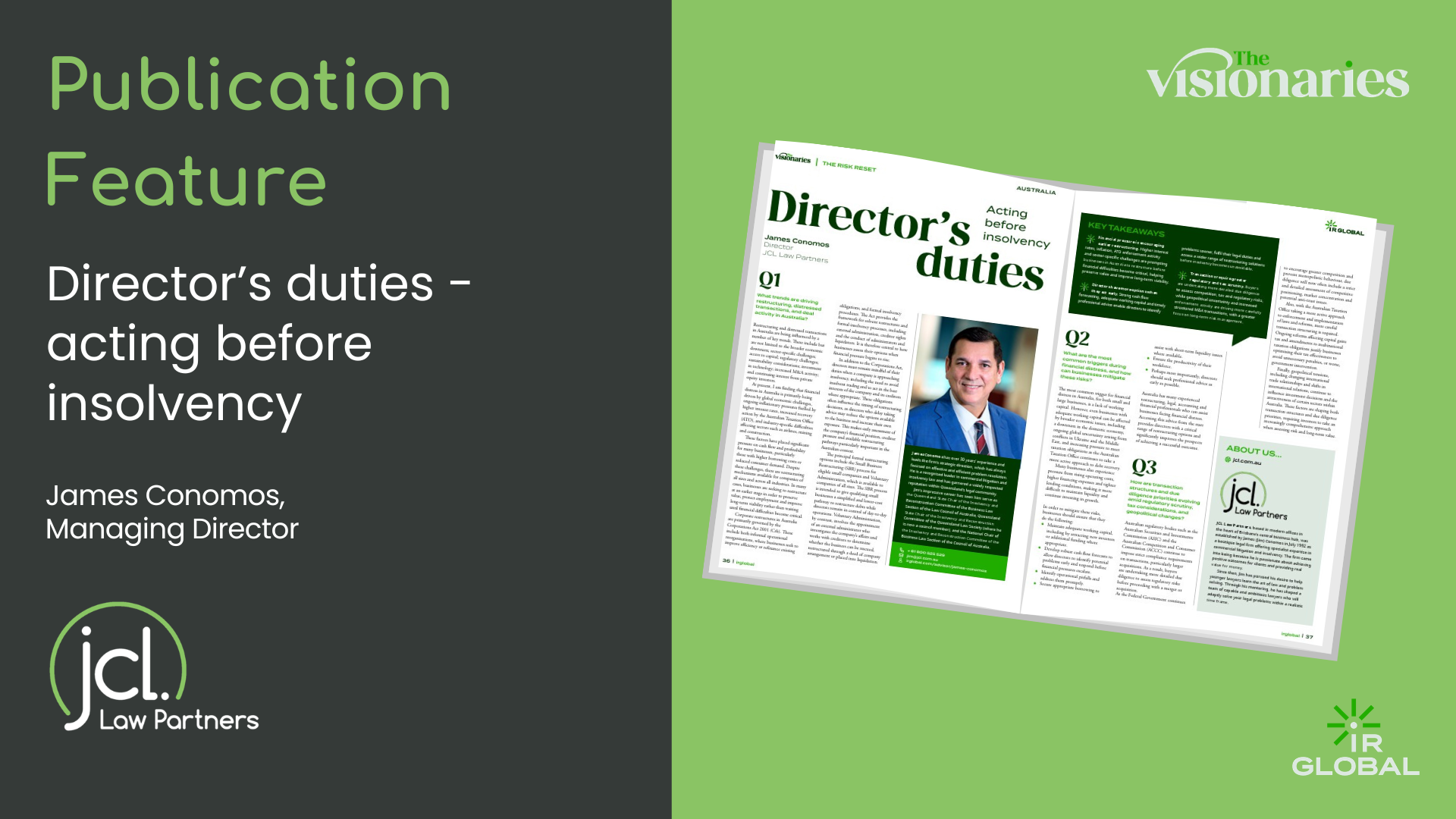
Director’s duties – acting before insolvency
What trends are driving restructuring, distressed transactions, and deal activity in Australia?
Restructuring and distressed transactions in Australia are being influenced by a number of key trends. These include but are not limited to the broader economic downturn; sector-specific challenges; access to capital; regulatory challenges; sustainability considerations; investment in technology; increased M&A activity; and continuing interest from private equity investors.
At present, I am finding that financial distress in Australia is primarily being driven by global economic challenges, ongoing inflationary pressures fuelled by higher interest rates, increased recovery action by the Australian Taxation Office (ATO), and industry-specific difficulties affecting sectors such as airlines, mining and construction.
These factors have placed significant pressure on cash flow and profitability for many businesses, particularly those with higher borrowing costs or reduced consumer demand. Despite these challenges, there are restructuring mechanisms available for companies of all sizes and across all industries. In many cases, businesses are seeking to restructure at an earlier stage in order to preserve value, protect employment and improve long-term viability rather than waiting until financial difficulties become critical.
Corporate restructures in Australia are primarily governed by the Corporations Act 2001 (Cth). These include both informal operational reorganisations, where businesses seek to improve efficiency or refinance existing obligations, and formal insolvency procedures. The Act provides the framework for solvent restructures and formal insolvency processes, including external administration, creditor rights and the conduct of administrators and liquidators. It is therefore central to how businesses assess their options when financial pressure begins to rise.
In addition to the Corporations Act, directors must remain mindful of their duties when a company is approaching insolvency, including the need to avoid insolvent trading and to act in the best interests of the company and its creditors where appropriate. These obligations often influence the timing of restructuring decisions, as directors who delay taking advice may reduce the options available to the business and increase their own exposure. This makes early assessment of the company’s financial position, creditor pressure and available restructuring pathways particularly important in the Australian context.
The principal formal restructuring options include the Small Business Restructuring (SBR) process for eligible small companies and Voluntary Administration, which is available to companies of all sizes. The SBR process is intended to give qualifying small businesses a simplified and lower-cost pathway to restructure debts while directors remain in control of day-to-day operations. Voluntary Administration, by contrast, involves the appointment of an external administrator who investigates the company’s affairs and works with creditors to determine whether the business can be rescued, restructured through a deed of company arrangement or placed into liquidation.
What are the most common triggers during financial distress, and how can businesses mitigate these risks?
The most common trigger for financial distress in Australia, for both small and large businesses, is a lack of working capital. However, even businesses with adequate working capital can be affected by broader economic issues, including a downturn in the domestic economy, ongoing global uncertainty arising from conflicts in Ukraine and the Middle East, and increasing pressure to meet taxation obligations as the Australian Taxation Office continues to take a more active approach to debt recovery.
Many businesses also experience pressure from rising operating costs, higher financing expenses and tighter lending conditions, making it more difficult to maintain liquidity and continue investing in growth.
In order to mitigate these risks, businesses should ensure that they do the following:
- Maintain adequate working capital, including by attracting new investors or additional funding where appropriate.
- Develop robust cash flow forecasts to allow directors to identify potential problems early and respond before financial pressures escalate.
- Identify operational pitfalls and address them promptly.
- Secure appropriate borrowing to assist with short-term liquidity issues where available.
- Ensure the productivity of their workforce.
- Perhaps most importantly, directors should seek professional advice as early as possible.
Australia has many experienced restructuring, legal, accounting and financial professionals who can assist businesses facing financial distress. Accessing this advice from the start provides directors with a critical range of restructuring options and significantly improves the prospects of achieving a successful outcome.
How are transaction structures and due diligence priorities evolving amid regulatory scrutiny, tax considerations, and geopolitical changes?
Australian regulatory bodies such as the Australian Securities and Investments Commission (ASIC) and the Australian Competition and Consumer Commission (ACCC) continue to impose strict compliance requirements on transactions, particularly larger acquisitions. As a result, buyers are undertaking more detailed due diligence to assess regulatory risks before proceeding with a merger or acquisition.
As the Federal Government continues to encourage greater competition and prevent monopolistic behaviour, due diligence will now often include a strict and detailed assessment of competitive positioning, market concentration and potential anti-trust issues.
Also, with the Australian Taxation Office taking a more active approach to enforcement and implementation of laws and reforms, more careful transaction structuring is required. Ongoing reforms affecting capital gains tax and amendments to multinational taxation obligations justify businesses optimising their tax effectiveness to avoid unnecessary penalties, or worse, government intervention.
Finally, geopolitical tensions, including changing international trade relationships and shifts in international relations, continue to influence investment decisions and the attractiveness of certain sectors within Australia. These factors are shaping both transaction structures and due diligence priorities, requiring investors to take an increasingly comprehensive approach when assessing risk and long-term value.

ADR by Default: Why Commercial Disputes Now Start Outside the Courtroom
Alternative Dispute Resolution (ADR) is an effective way to resolve commercial disputes and has long been recognised as such. Its role has changed in recent years though - what was once considered an alternative to litigation is often now the starting point.
Across Australia, courts are placing greater emphasis on mediation and other forms of ADR at an early stage of proceedings. It should therefore be noted that businesses approaching ADR as a procedural hurdle, rather than a genuine opportunity to resolve a dispute, may find themselves at a strategic disadvantage before the matter reaches a courtroom.
ADR Is No Longer an Afterthought
Commercial litigation has become more focused on efficiency, proportionality and early resolution. As a part of this, courts are encouraging - or in many cases requiring - parties to participate in mediation or other ADR processes before a dispute progresses further.
Aside from reducing court workloads, early resolution usually minimises legal costs, preserving commercial relationships and allowing businesses to resolve disputes more quickly than traditional litigation.
Subsequently, the first substantive negotiation now takes place around a mediation table for many businesses.
Early Preparation Still Matters
Preparedness is usually the key for mediation to be successful. The businesses achieving the best outcomes are generally those that have invested time in understanding both the legal and commercial aspects of their position before ADR has begun.
This can involve reviewing contractual obligations and identifying the key factual issues, as well as preserving relevant documents and assessing the strengths and weaknesses of the case. It should also include a realistic understanding of the commercial objectives sitting behind the dispute.
Approaching mediation without that preparation can result in missed opportunities, unrealistic expectations or unnecessary costs should the matter ultimately proceed to litigation.
ADR Can Reduce Cost and Uncertainty
One of the biggest advantages of ADR is its ability to resolve disputes without the expense and delay associated with a trial.
Commercial litigation can involve lengthy disclosure exercises, expert reports, interlocutory applications and extensive preparation before a matter reaches a final hearing. ADR provides an opportunity to narrow the issues or resolve the dispute before those costs escalate.
Even where a complete settlement is not achieved, mediation often identifies areas of agreement and clarifies the issues that genuinely remain in dispute. Usually, this will significantly reduce the time and expense involved if court proceedings continue.
Settlement Leverage Begins Early
Many commercial disputes do settle before reaching trial, but the strength of a party's negotiating position tends to be established before formal mediation begins.
Clear evidence, well-prepared legal arguments and a realistic assessment of commercial risk all strengthen a party's position during settlement discussions. On the reverse, uncertainty around the facts or an unwillingness to engage constructively may weaken leverage and reduce the prospects of an early resolution.
Businesses should therefore view ADR as part of their wider litigation strategy rather than a separate process that sits alongside or precurses it.
Preserving Commercial Relationships
Unlike litigation, ADR is designed to encourage discussion rather than confrontation. This can be particularly valuable where the parties have an ongoing commercial relationship or may continue working together once the dispute has been resolved.
Disagreements between shareholders, suppliers, contractors or business partners likely involve relationships that extend beyond the immediate dispute. Resolving those matters through negotiation or mediation allows businesses to preserve valuable commercial connections while still protecting their legal interests.
Confidentiality is an additional benefit. Court proceedings are generally conducted in public, but mediation allows parties to explore settlement options privately and without creating unnecessary reputational risk.
Courts Expect Genuine Participation
Australian courts increasingly expect parties to engage meaningfully in ADR rather than simply attending because they have been directed to do so.
A party that refuses to participate constructively, adopts an unreasonable position or ignores genuine opportunities to settle may expose itself to adverse costs consequences later in the proceedings.
For that reason, preparation extends beyond understanding the legal issues. Businesses should also consider what commercial outcomes they would be willing to accept and where there may be scope for compromise.
Choosing the Right Strategy
Not every dispute is suitable for early settlement. Some matters involve legal principles that require judicial determination, while others demand urgent court intervention to preserve assets or protect legal rights.
The key is identifying the most appropriate pathway at the earliest stage. In many commercial disputes, ADR offers an opportunity to resolve matters efficiently while maintaining greater control over both the process and the outcome.
Where litigation remains necessary, the work undertaken during early ADR often provides valuable insight into the strengths of each party's case and can help shape the strategy moving forward.
Preparation Creates Opportunity
With commercial disputes often beginning outside the courtroom, businesses that prepare thoroughly before mediation are often better placed to control costs, negotiate from a position of strength and identify opportunities for early resolution.
Whether a matter settles or proceeds to litigation, the work completed before the first ADR process can influence the direction of the dispute from the outset.
If your business is involved in a commercial dispute, obtaining legal advice early can help you prepare effectively for mediation, protect your position and make informed decisions about the best way forward.
Contact us to discuss how we can help you achieve a practical and commercially focused outcome.

Commercial Litigation in 2026: Why the First 90 Days Decide Everything
Commercial litigation in Australia is becoming increasingly front-loaded, with courts placing greater emphasis on early evidence preservation, tighter pleadings and faster case management. Businesses delaying preparation can find themselves at a strategic disadvantage before proceedings have properly begun.
The first 90 days of a dispute now carry far more weight than they once did. Early decisions around evidence, pleadings, internal investigations and strategy often shape the direction, cost and timing of the entire matter.
Litigation Is Becoming More Front-Loaded
Australian courts are placing increasing pressure on parties to identify the real issues in dispute early and move matters forward efficiently. Strict procedural timetables, early disclosure obligations and active judicial case management mean businesses can no longer afford to take a reactive approach once proceedings commence.
The opening stages of litigation are no longer simply procedural groundwork. They often determine how much leverage a party has throughout the life of the dispute.
Poor preparation at the outset can create problems that become expensive and difficult to fix later. Delays in securing evidence, inconsistent internal communications or poorly framed pleadings can weaken a party’s position before the substantive issues are even argued.
Early Evidence Preservation Matters
In most commercial disputes, documents are central. Emails, contracts, internal messaging platforms, meeting records, financial data and digital audit trails frequently become key evidence.
The difficulty is that electronic material can disappear quickly. Devices are replaced, staff leave businesses, files are overwritten and records are deleted as part of ordinary business operations. Once litigation is anticipated, failing to preserve relevant material can create significant evidentiary issues.
Businesses that act early are generally in a much stronger position. Preserving records, identifying key custodians and conducting early document reviews can reduce uncertainty and prevent disputes about missing or incomplete evidence later in the proceeding.
Metadata and digital records are also becoming increasingly important, particularly where the authenticity or timing of documents is challenged.
Pleadings Are More Important Than Ever
Commercial pleadings are becoming increasingly strategic. Courts expect parties to properly articulate their claims and defences at an early stage, rather than refining them gradually over time.
A well-prepared pleading does more than outline allegations. It frames the dispute, influences disclosure obligations, shapes interlocutory applications and can affect settlement discussions from the outset.
By contrast, vague or poorly prepared pleadings can expose weaknesses, increase legal costs and damage credibility with both the court and the opposing party.
For businesses involved in significant disputes, investing time in early case analysis can materially affect how the litigation progresses.
Faster Case Management Is Changing Litigation Strategy
Commercial courts across Australia continue to focus on efficiency and proportionality. Judges are showing less tolerance for unnecessary delay, excessive document disputes and procedural tactics that do little to advance the real issues.
This has changed the practical reality of litigation. Parties are often required to make important strategic decisions much earlier than they previously would have. Decisions about evidence preservation, expert engagement, interlocutory applications and settlement positioning may need to occur within weeks of proceedings commencing.
Businesses that are unprepared can quickly find themselves reacting to deadlines and procedural pressure instead of controlling the direction of the matter.
The First 90 Days Often Shape Commercial Leverage
Most commercial disputes still resolve before trial, but the strength of a party’s negotiating position is often established very early.
Strong evidence, organised preparation and clearly articulated claims can place significant pressure on the opposing party from the beginning. On the other hand, evidentiary gaps, inconsistent positions or delays in responding can weaken leverage and increase costs.
The early stages of litigation also influence timing and commercial outcomes. Narrowing issues early, preserving key evidence and identifying realistic objectives can create opportunities for efficient resolution before costs escalate further.
Businesses Should Prepare Before Litigation Escalates
One of the most common issues in commercial disputes is delay in seeking advice. By the time legal assistance is obtained, businesses may already have lost access to key records, compromised internal communications or missed opportunities to protect their position.
Commercial disputes should be treated in the same way businesses approach regulatory or cyber risk - preparation before a crisis develops is critical.
Practical steps include:
- maintaining reliable document retention systems
- implementing internal escalation processes for disputes
- preserving communications once litigation is anticipated
- identifying key decision-makers early
- seeking legal advice before responding under commercial pressure
These steps can significantly reduce risk and place businesses in a stronger position if proceedings become unavoidable.
Courts Are Continuing to Push Efficiency
Australian courts have repeatedly emphasised the importance of efficient case management and early identification of issues in commercial proceedings. The Federal Court’s Central Practice Note last year reflects the broader shift towards proportionality, efficient conduct and reducing unnecessary delay in litigation.
This broader procedural trend is continuing to influence how commercial disputes are managed across Australia.
Preparation Can Shape the Entire Dispute
Commercial litigation in 2026 is faster, more document-heavy and more strategically demanding than it was only a few years ago. Businesses that delay preparation may find themselves losing valuable leverage before the dispute has properly developed.
Early evidence preservation, careful pleadings and a clear litigation strategy can significantly affect cost, timing and commercial outcomes.
If your business is facing a potential dispute, early advice can help protect your position and avoid unnecessary risk later in the process. Contact us to discuss how we can help you protect your position from the very beginning.

JCL Law Partners Receives Recognition from Best Lawyers and Best Law Firms - Australia 2027
JCL Law Partners is pleased to announce its inclusion in the 2027 edition of Best Law Firms - Australia, recognising the firm’s expertise across its core practice areas. The firm is ranked as Tier 1 for Insolvency and Reorganisation Law in Brisbane.
The Best Law Firms rankings are based on extensive research, including feedback from clients, peer reviews, and interviews with legal professionals, reflecting a strong reputation for quality and professionalism within the industry.
In addition to the firm’s recognition, Founder and Director James Conomos has again been recognised in the 2027 edition of The Best Lawyers in Australia for his expertise in Insolvency and Reorganisation Law in Brisbane.
This dual recognition highlights both the strength of the firm as a whole and the depth of experience within our leadership. JCL Law Partners continues to focus on delivering practical, results-driven legal advice across commercial litigation, insolvency, and restructuring matters.
The firm acknowledges this recognition as a reflection of our ongoing commitment to client service, technical expertise, and achieving effective outcomes.

JCL Law Partners Director Adrian Robins Heads to Vancouver for IR Global ‘On the Road’ Conference
Very soon, JCL Law Partners Director Adrian Robins will attend IR Global’s next ‘On the Road’ Conference in Vancouver, taking place from 9th - 13th June at the Pan Pacific Waterfront.
The conference will bring together professionals from across the globe, providing a valuable opportunity to connect with fellow members of the IR Global network and strengthen relationships across key international jurisdictions.
The program features a full schedule of panel discussions, breakout sessions, and networking events, all designed to encourage collaboration, knowledge-sharing, and practical insights across a range of practice areas.
For JCL Law Partners, maintaining a strong global network is essential. Attending events such as this allows us to stay connected with trusted advisors worldwide, ensuring we can continue to support our clients with cross-border matters and international opportunities.
Adrian looks forward to engaging with colleagues in Vancouver and continuing to build meaningful connections within the IR Global network.

JCL Law Partners adds Adam Carr as a Rising Star to the IR Global Network
JCL Law Partners is pleased to share that Senior Associate Adam Carr has joined IR Global as a Rising Star.
The Rising Star category recognises emerging professionals within member firms who are actively involved in building relationships across the network and contributing to international collaboration.
IR Global is a leading multi-disciplinary professional services network, connecting advisors worldwide to support clients on cross-border matters. Adam’s inclusion reflects his growing involvement in the firm’s international work and his commitment to engaging with the global professional community.
He joins JCL Law Partners’ existing IR Global members, including Founder and Managing Director James Conomos, Director Adrian Robins, and Practice Manager Justine Fletcher.
We look forward to Adam’s continued contribution to both the firm and the IR Global network.

AI Evidence Is Coming to Court: Authenticity, Manipulation, and Proof
Artificial intelligence is no longer just a business tool. It is increasingly part of the evidentiary landscape, and it is beginning to affect how disputes are run and how digital material is assessed in litigation. Emails drafted with AI assistance, AI-generated reports, deepfake-style audio or video, altered voice recordings and synthetic documents are now realistic possibilities in commercial disputes.
Australian courts are now confronting a practical question: can digital evidence still be trusted in the same way it once was?
For businesses, this is not an abstract concern. Many disputes turn on what was said in an email, what was agreed in a message thread, or what was captured in a recording. If those materials are challenged as manipulated or fabricated, the dispute can quickly shift away from the underlying commercial issue and into a technical contest about authenticity and proof. Understanding how courts approach authenticity is becoming critical.
The Rise of Synthetic Content
AI tools can now generate convincing text, images, audio and video in seconds. Many of these tools are used legitimately and responsibly in everyday business operations. However, the same technology can also be used to fabricate documents, mimic voices, alter recordings or create realistic but false digital material.
The issue is not simply that this can be done, but that it can be done cheaply and without specialist expertise. A fabricated email chain can be made to look genuine. A recording can be edited to alter meaning without obvious signs of tampering. A document can be subtly amended before it is produced in proceedings. These are no longer remote or hypothetical scenarios.
In commercial litigation, where digital documents often form the backbone of a claim or defence, this creates a new layer of risk.
Authenticity and Proof in Australian Courts
The rules of evidence have not fundamentally changed. Whether proceedings are governed by the Uniform Evidence Acts (including the Evidence Act 1995 (Cth) and equivalent State legislation) or Queensland’s Evidence Act 1977 (Qld), parties must still establish that the material they rely upon is what it purports to be and can be treated as reliable.
Historically, authenticity disputes have often been resolved through relatively straightforward evidence about authorship, storage and alteration. In many cases, the reliability of a document was assumed unless there was a clear basis to doubt it.
AI alters that landscape. Manipulation may not leave obvious traces. AI-generated content can appear coherent, professional and entirely plausible, even if it is false. This does not mean courts will accept AI-affected material without scrutiny. If anything, it increases the importance of demonstrating the provenance and integrity of digital records.
Metadata, audit trails, server logs and, in some cases, forensic expert evidence are likely to become increasingly significant.
The Burden of Proof Has Not Changed
Even as technology evolves, the legal principles remain steady. The party relying on a document or recording continues to bear the burden of proving authenticity and relevance. What is changing is the complexity of proving it.
A dispute that once focused squarely on commercial facts may instead become dominated by questions about document history, file creation, access permissions, version control and whether AI tools were used to generate or modify the material. That shift can add cost, delay and uncertainty to proceedings, even where the evidence ultimately proves genuine.
For businesses involved in high-value disputes, strong document governance and secure record-keeping are becoming strategic safeguards.
Deepfakes and Altered Recordings
One of the most concerning developments is the rise of deepfake audio and video. In commercial disputes, recordings of meetings, negotiations or phone calls can be decisive. If a party alleges that a recording has been altered or synthetically generated, the evidentiary dispute may become as significant as the underlying commercial claim.
Even where allegations are unfounded, the widespread availability of AI tools makes authenticity easier to challenge. This can delay proceedings, complicate settlement discussions and require additional expense for technical analysis or expert reports.
Courts are alert to these risks, and challenges to electronic recordings are likely to become more frequent as the technology evolves.
Courts Are Already Responding
Australian courts have begun addressing AI-related risks directly, particularly in relation to litigation documents and submissions. In September 2025, the Supreme Court of Queensland issued Practice Direction No. 5 of 2025, acknowledging the increasing use of artificial intelligence in litigation while warning that generative AI tools may produce apparently plausible but inaccurate or fictitious material. The Court emphasised that responsibility for accuracy and integrity remains with the party and their legal representatives.
The message is clear: AI may be used as a tool, but it does not dilute professional and evidentiary obligations.
What Businesses Should Be Doing Now
The most effective response to authenticity challenges is preparation. Businesses should not wait for litigation to consider whether their digital records would withstand close scrutiny.
Robust document management systems, secure storage practices and disciplined version control are increasingly important. Preserving metadata and maintaining clear audit trails can be critical if authenticity is questioned.
Internal awareness also matters. Staff should understand that AI tools can introduce risk, particularly in sensitive communications, contract drafting or internal reporting. Clear policies about when AI may be used and how that use is documented can significantly strengthen a business’s position if evidence is challenged.
These measures do not eliminate risk, but they enhance credibility - and credibility often shapes outcomes.
AI as Evidence in Its Own Right
In some disputes, AI systems themselves may become the subject of evidence. A claim may turn on how an algorithm reached a decision, whether it relied on flawed data, or whether an automated process operated as intended.
In those cases, transparency and documentation become critical. Businesses deploying AI tools in operational or decision-making contexts should be able to explain how those systems function, what data they rely upon and what safeguards are in place. Without that clarity, defending a claim may become considerably more difficult.
Early Legal Strategy Matters
Disputes involving digital evidence and allegations of manipulation are rarely straightforward. They often require early strategic decisions about preservation of records, forensic investigation and expert engagement. Acting too late can result in loss of metadata, incomplete audit trails or an inability to clearly explain how evidence was created and stored.
Early advice and timely evidence preservation can shape the direction and sometimes the outcome of a dispute.
A New Evidentiary Landscape
AI is not replacing the legal system, but it is reshaping how evidence is created, challenged and proved. As synthetic content becomes more sophisticated and accessible, authenticity is likely to become a more frequent battleground in commercial litigation.
Strong governance, secure systems and proactive planning are increasingly essential. Where the authenticity of digital evidence is questioned, preparation may determine whether a business can prove its case, defend its position or resolve the dispute efficiently.
If your organisation is navigating a dispute involving digital material, or is seeking to strengthen its internal safeguards before one arises, careful legal planning now may avoid far greater difficulty later.
As the evidentiary landscape continues to evolve, preparation matters. If you would like to strengthen your internal safeguards or seek advice on a current dispute, our team is here to assist. Contact us to start protecting your position with confidence.

JCL Law Partners to Sponsor IR Global’s ‘On the Road’ Conference Dinner in Singapore
Next month, James Conomos (Managing Director) and Justine Fletcher (Practice Manager) will be attending IR Global’s latest ‘On the Road’ Conference in Singapore. JCL Law Partners will have the pleasure of sponsoring the event’s luxury networking dinner at the idyllic Artemis Grill.
Jim will be connecting with professionals from a wide range of jurisdictions across the Asia-Pacific region, providing a valuable opportunity to engage with peers from around the world.
The program offers a strong mix of learning and networking, with presentations, breakout sessions, and social events hosted in premium venues throughout one of Asia’s most vibrant cities.
In today’s increasingly connected landscape, a strong international network is essential. By attending events like this, we continue to strengthen our global relationships and enhance the breadth of support we can offer our clients.
